IR Deck Meaning and What to Include
An IR deck is a startup's investor pitch deck. See the slide order investors expect and how the pitch changes for demo days, partner meetings, and decks you send ahead.
You have a demo day slot next month, a first call with a partner this week, and an investor who just asked you to "send the deck." Each wants a different version of the same story: a one- or two-minute pitch on stage, an hour of questions in a partner meeting, and a deck that makes sense in the two or three minutes an investor spends reading it alone.
MOVO starts from what you already have. Attach a company profile, notes, or a results spreadsheet, and MOVO shows a slide-by-slide outline before it builds anything. Set the slide count for the room you are pitching, edit and reorder the outline, pick a design, and the slides are built; if a number is wrong, select that slide and fix only that part. This guide covers what an IR deck is, the slide order investors expect, how the pitch changes from demo day to partner meeting, how to write traction metrics, the MOVO workflow, and templates you can copy.
What is an IR deck?
An IR deck is a startup's investor pitch deck: the slides that show investors the problem, the product, the market, traction, the team, and how much you are raising. "IR" stands for investor relations. Founders in Korea often call their pitch deck an "IR deck," while US founders and investors say "pitch deck" or just "deck." In the US, "investor relations" usually means how a public company communicates with its shareholders (NIRI), so with US investors, "pitch deck" avoids confusion.
What should an IR deck include, and in what order?
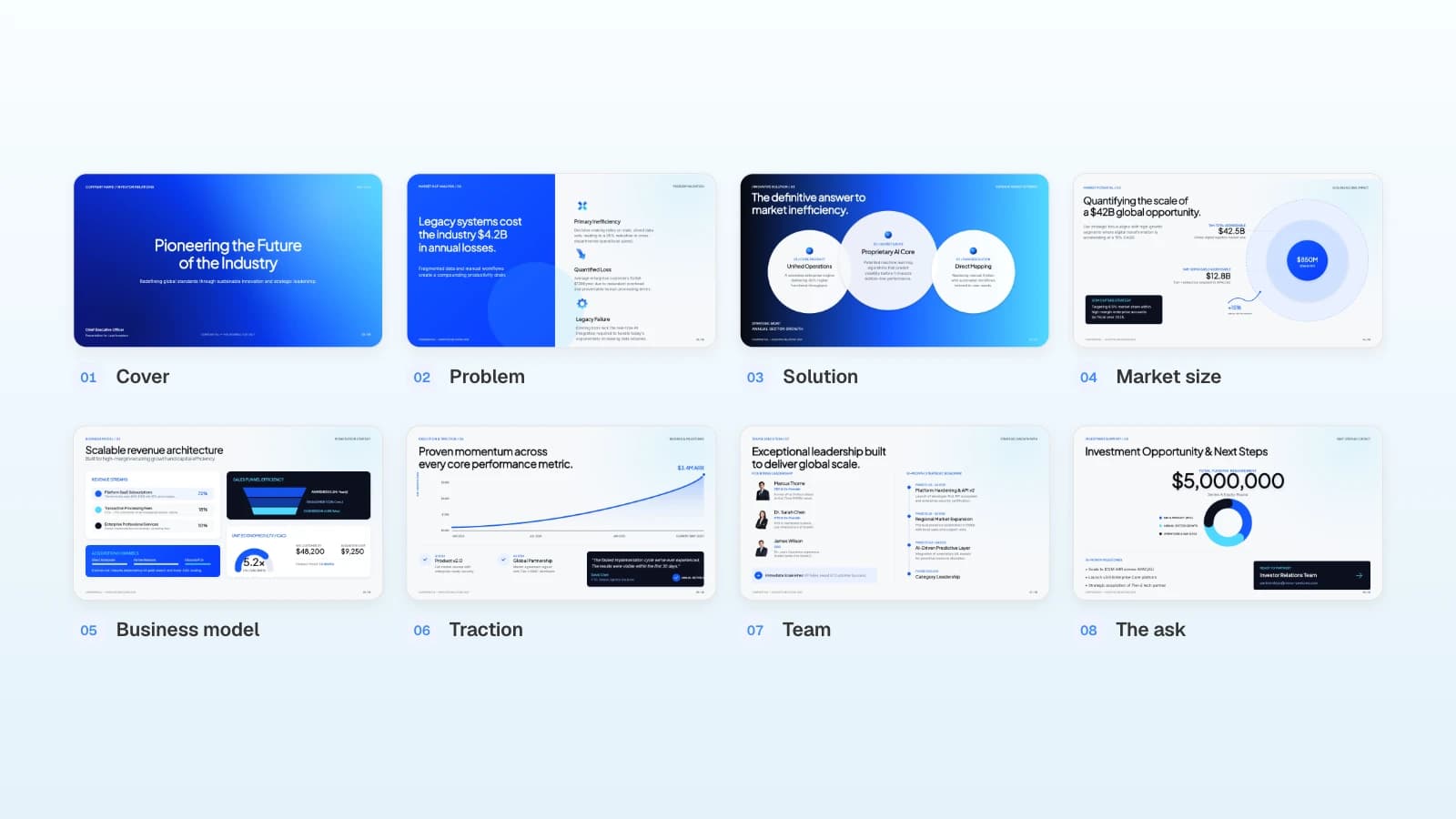
Most investor decks follow one arc: problem → solution → market → business model → traction → team → the ask. Sequoia's outline lists ten sections: company purpose, problem, solution, why now, market potential, competition, business model, team, financials, and vision (Sequoia). Y Combinator's Michael Seibel reduces a seed pitch to seven questions: what you do, how big the market is, what progress you have made, your unique insight, how you make money, who is on the team, and what you are asking for (Y Combinator).
| Slide | Question it answers | What to prepare |
|---|---|---|
| 1. Cover | Who are you and what do you do, in one line? | Company name, round, one-line pitch |
| 2. Problem | Whose problem, and how costly is it? | Observations, customer interviews |
| 3. Solution | How do you solve it? | How it works and where it stands today |
| 4. Market size | Who could buy, and how much? | Market definition with sources |
| 5. Business model | How do you make money? | Pricing, revenue streams, assumptions |
| 6. Traction | What have you proven so far? | Metrics with definitions and periods |
| 7. Team | Why is this the team to do it? | Relevant experience and roles |
| 8. The ask | How much, for what, and until when? | Amount, use of funds, milestones |
Add product, competition, or roadmap slides when your story needs them. In DocSend's research, decks run about 20 pages with about 50 words per slide (DocSend). Do not delete evidence or invent results to hit a slide count.
How long is the pitch? Demo day, partner meeting, or a deck you send
The same story gets used three ways, and each has a different clock.
| Format | Time | Audience | What works |
|---|---|---|---|
| Accelerator demo day | 1–2 minutes | Hundreds of investors | A handful of slides, one idea each |
| Pitch competition | 6 minutes at Startup Battlefield, then Q&A | Judges and an audience | A live demo and a clear ask |
| First partner meeting | 30–45 minutes, one on one | One partner | The full story plus an appendix |
| Full partnership meeting | About 60 minutes with 5–15 investors | The partnership | About 15 slides plus an appendix |
| Deck sent ahead | 2–3 minutes of reading | One investor, alone | Slides that explain themselves |
Demo day: one idea per slide
- At Y Combinator's W22 Demo Day, every company had one minute to present (Y Combinator, 2022). In 2015, YC's Kevin Hale described a 2.5-minute Demo Day pitch and recommended about five to seven slides that are legible, simple, and obvious (Y Combinator, 2015).
- At 500 Global's flagship Demo Day in March 2023, 19 companies gave two-minute presentations (500 Global).
- For a five-minute slot, Techstars suggests about one minute of intro, two to three minutes of demo, a minute or so for the business case, and 30 seconds to land (Techstars).
- TechCrunch Startup Battlefield finalists pitch for six minutes on the Disrupt stage, followed by live questions from VC judges (TechCrunch).
Partner meetings: bring the appendix
- NFX describes the usual path: a first meeting with the partner who will champion you, a second meeting with more partners, diligence such as reference calls, then a pitch to the full partnership and a vote. Bring about 15 clean slides plus an appendix, and expect them to circulate inside the firm (NFX).
- First Round's Liz Wessel says a seed partner meeting typically includes 5–15 investors and runs about 60 minutes, versus 30–45 minutes for a one-on-one (First Round Review).
- Once first meetings go well, investors ask for a data room: the deck, cap table, historical P&L and burn, usage metrics, and LTV/CAC. a16z's Justine Moore notes that its numbers must match the deck, because investors use them in diligence and the investment memo (a16z).
A deck you send: it has to stand alone
- DocSend reported that investors' average time per deck fell to 2 minutes 24 seconds in Q4 2023, an all-time low at that point (DocSend, 2024).
- A send-ahead deck has no presenter, so each slide needs a headline that states its point. YC's Geoff Ralston suggests preparing a leave-behind deck plus a one- to two-page executive summary (Y Combinator).
How do you write traction metrics investors trust?
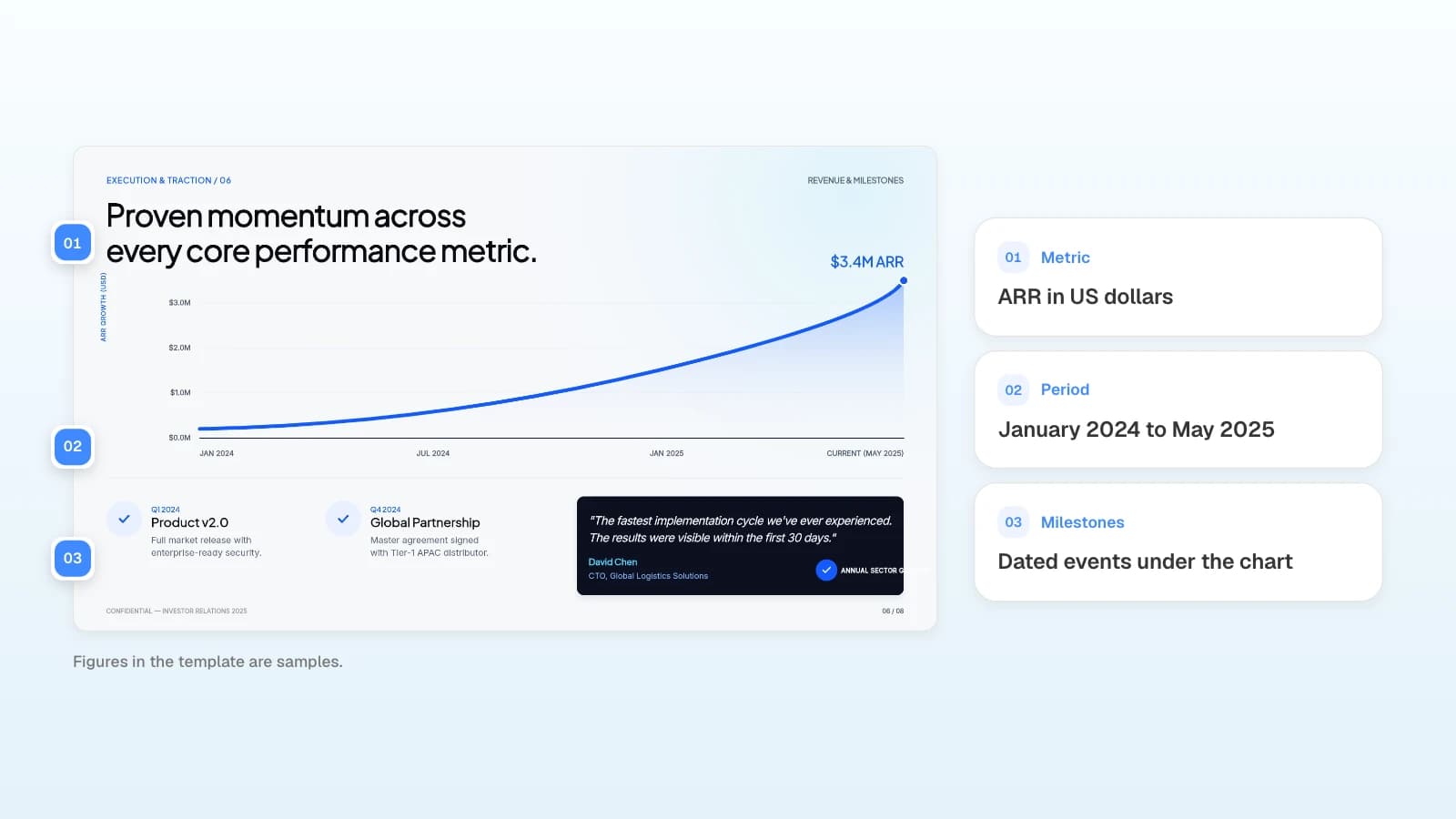
Give every metric a definition, a period, and a scope. Keep sign-ups apart from active users, and booked revenue apart from signed contracts or pipeline. If you have no results yet, describe the validation you actually ran, its limits, and the next question you will answer instead of filling the slide with estimates.
| Check | What to confirm |
|---|---|
| Definition | What exactly did you count: sign-ups, users, payments? |
| Period and base | From when to when, and who is included? |
| Kind of money | Is it recognized revenue, a signed contract, or a plan? |
| Comparability | Are periods, units, and definitions consistent? |
| Limits | What does the sample or observation window not cover? |
The same applies to market size. Check that the region, customer, and base year match your business, and cite the original source on the slide. Show any assumption about capturing a share of the market separately from results you have observed.
If you have a results spreadsheet, attach it to MOVO as is and write something like "chart monthly revenue, keep the numbers exactly as in the file." MOVO reads up to 20 sheets per Excel file. Check the numbers against the source after the deck is built.
How do you check the slides before you present?
Rehearse out loud against the clock, and keep one message per slide. Move details to the appendix, and make sure each title and chart tell the same story. Kevin Hale's three rules for pitch slides still hold: legible, simple, obvious (Y Combinator, 2015).
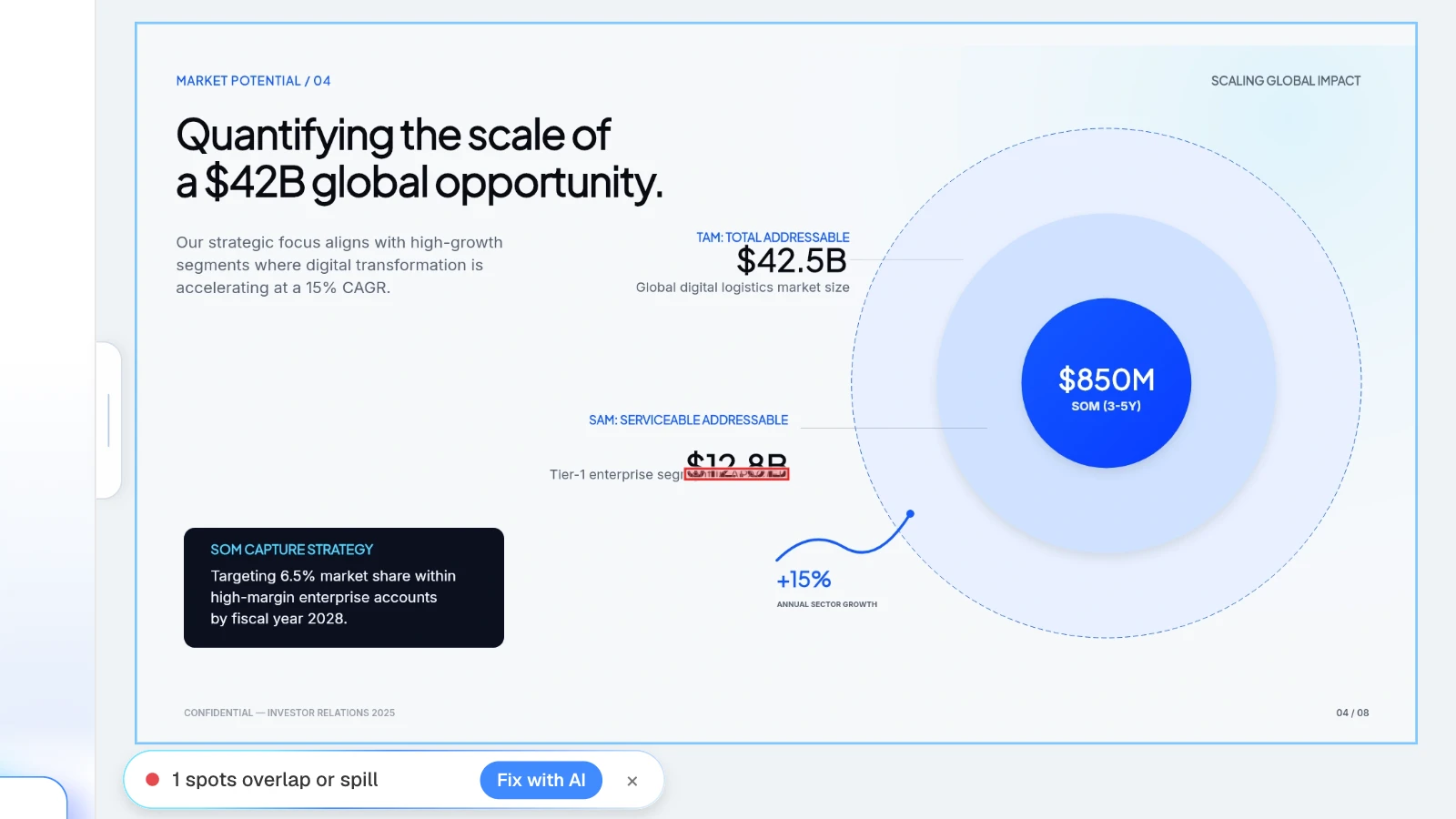
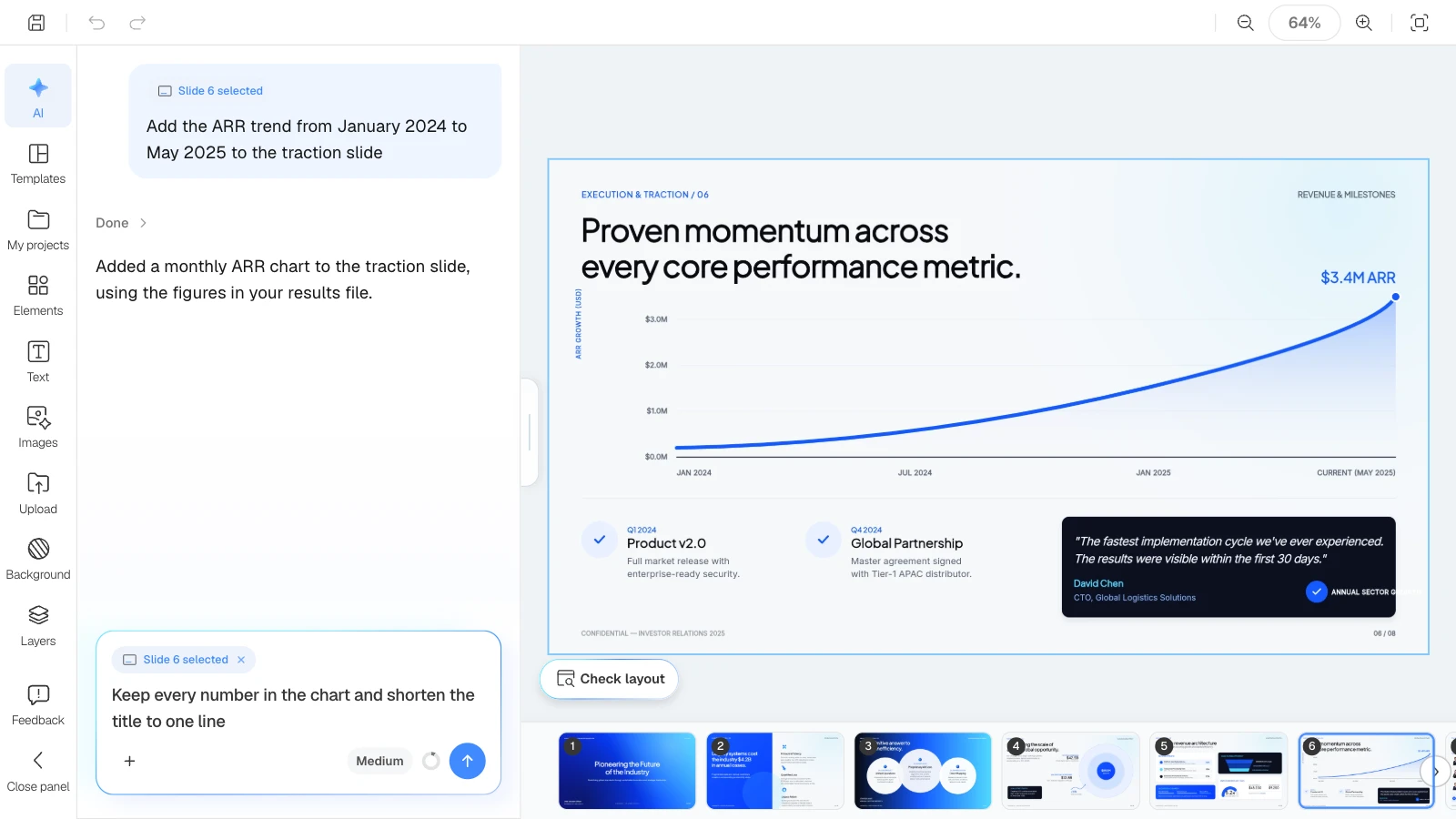
Editing numbers or lengthening a sentence is how text boxes end up overlapping. In the MOVO editor, click "Check layout" below the canvas: MOVO marks overlapping or spilling spots on the current slide in red, and "Fix with AI" asks the AI to tidy that part. Open the exported file once more before you send it.
What does MOVO change for an IR deck?
- Start from what you have: attach a company profile PDF (up to 100 pages), a Word document, or a results spreadsheet (up to 20 sheets). Save PPTX or HWP files as PDF first.
- Slide count and outline first: set the slide count when you start (five slides for a demo day, say), and MOVO shows every slide's title and content before building, so you can fix the content and order before any design work.
- Settings for investors: choose "Investor" as the audience, then narrow designs with the "Presentation / Pitch" document type.
- Fix one slide at a time: select a slide and ask, for example, "keep the numbers, shorten the title to one line"; only that slide changes. Check layout finds overlapping text boxes.
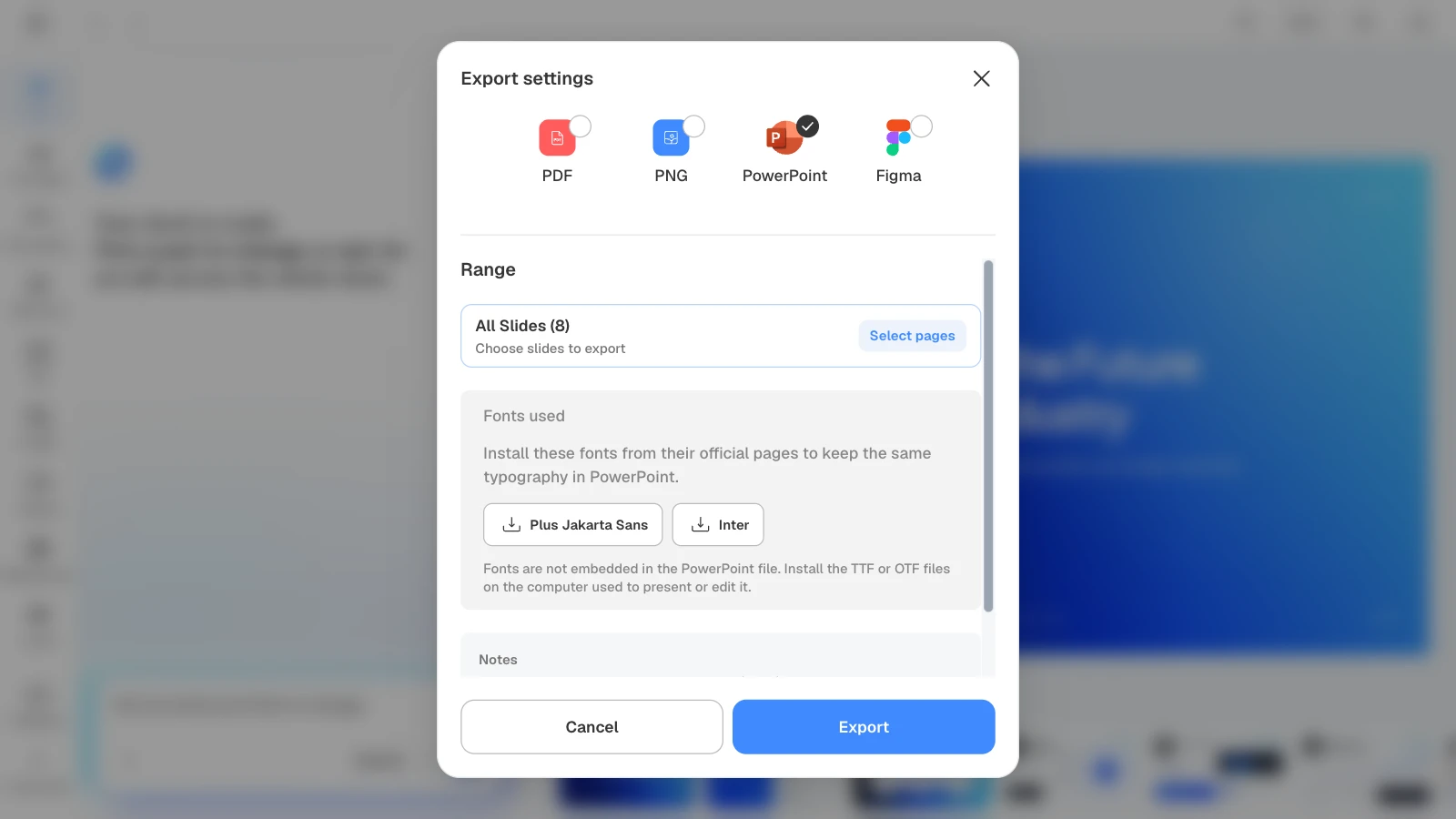
- Export files: PDF and PNG on every plan; PPTX and Figma on paid plans. A PPTX export stays editable in PowerPoint.
How to build an IR deck in MOVO
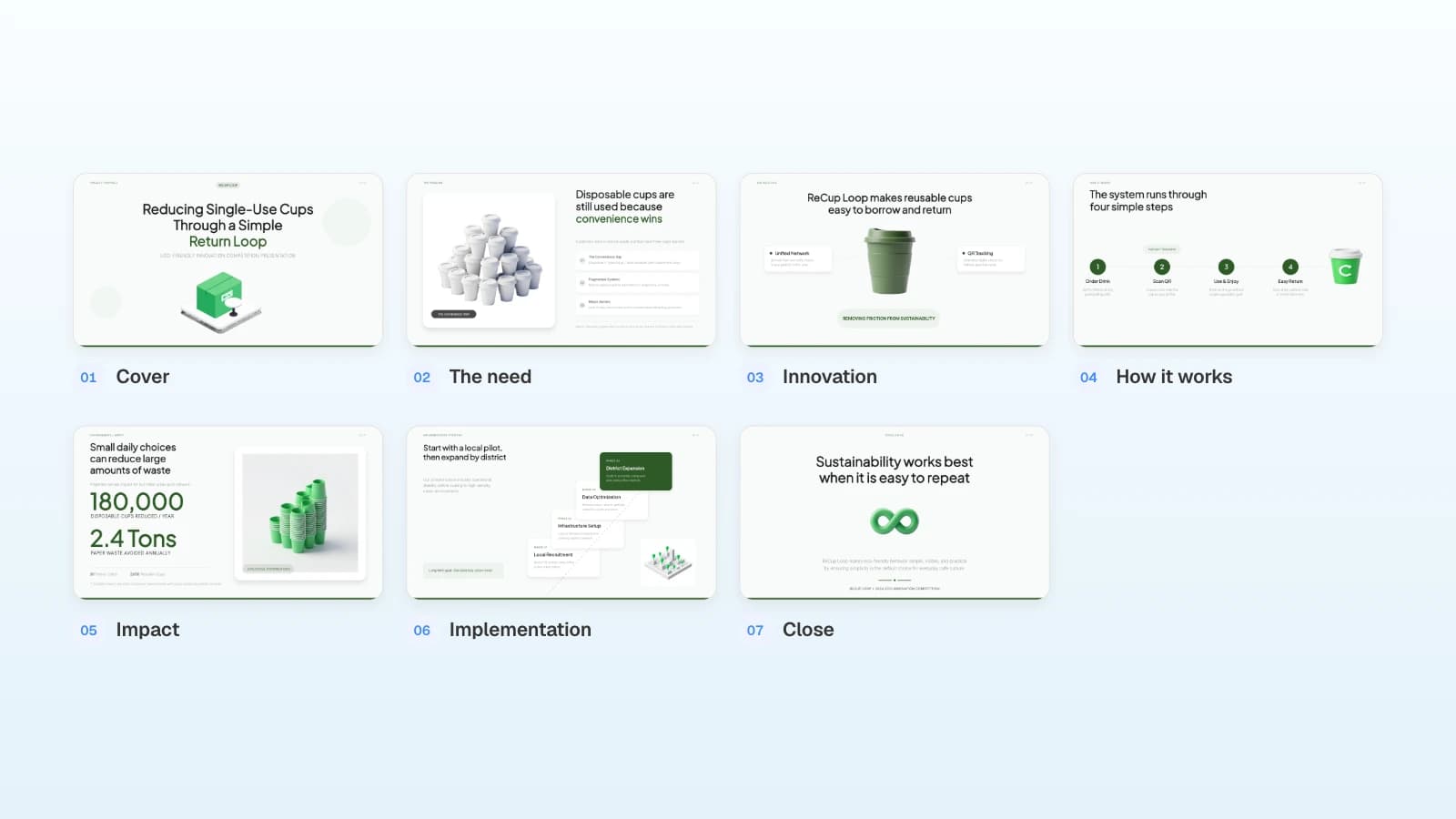
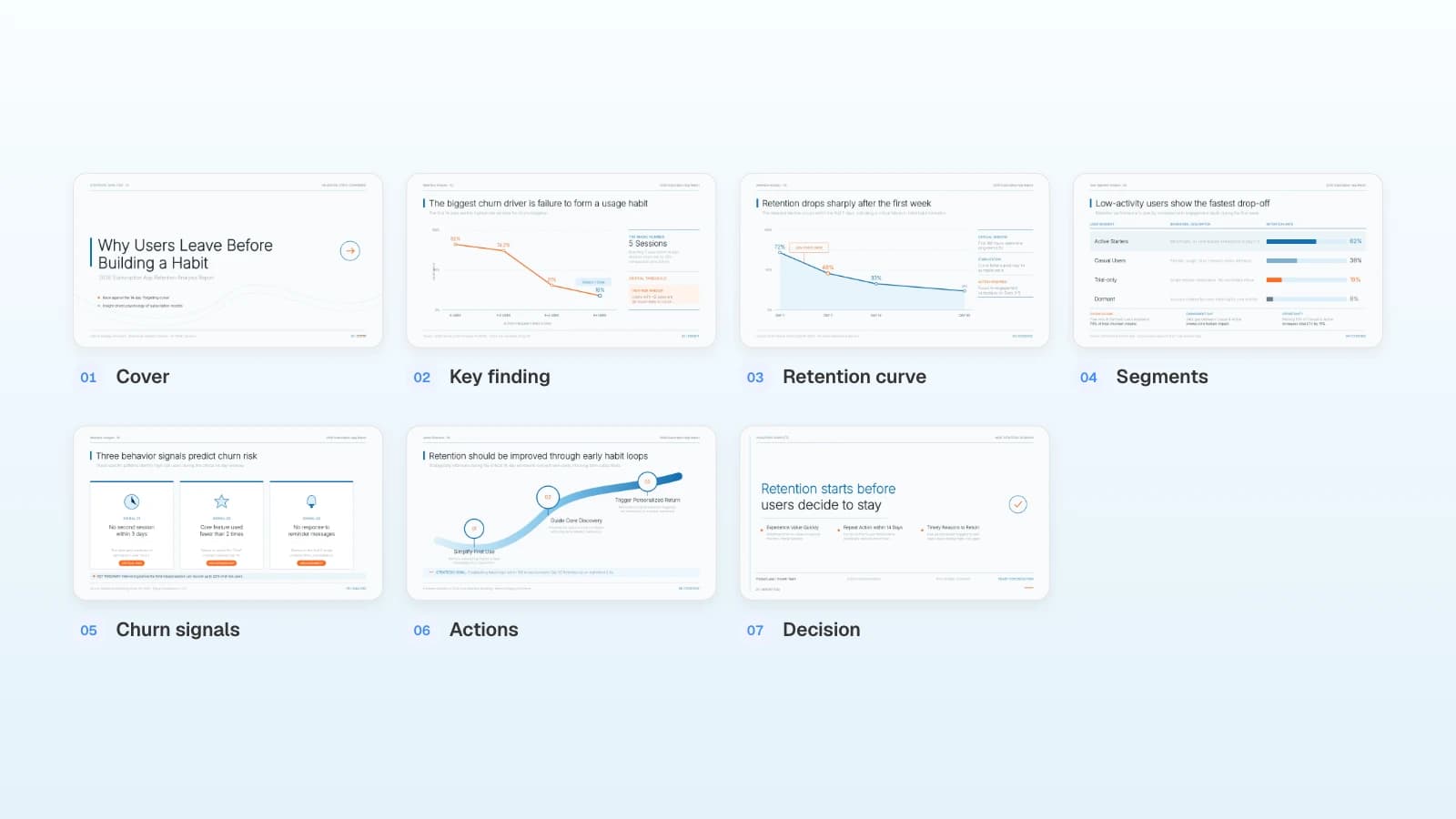
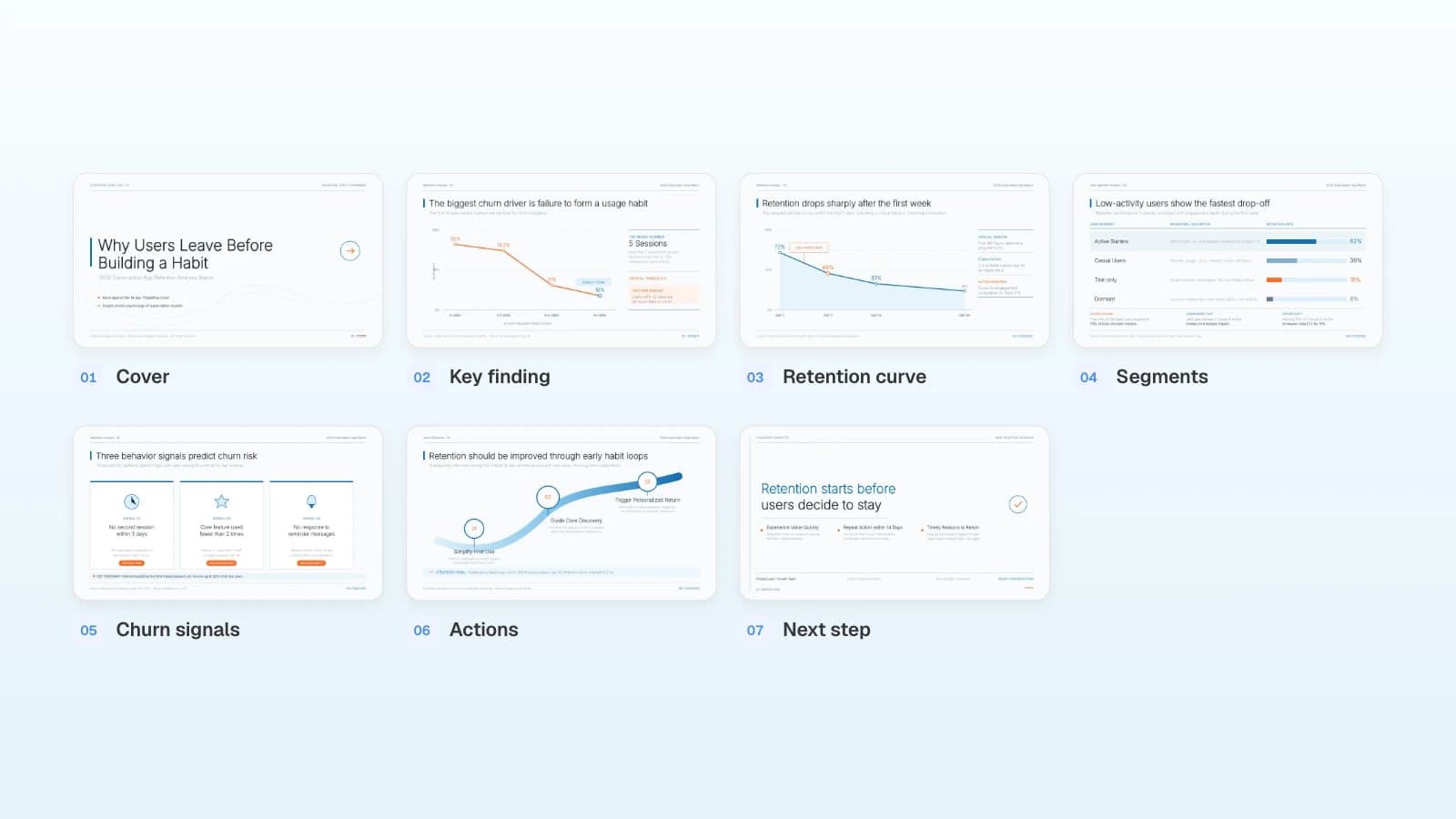
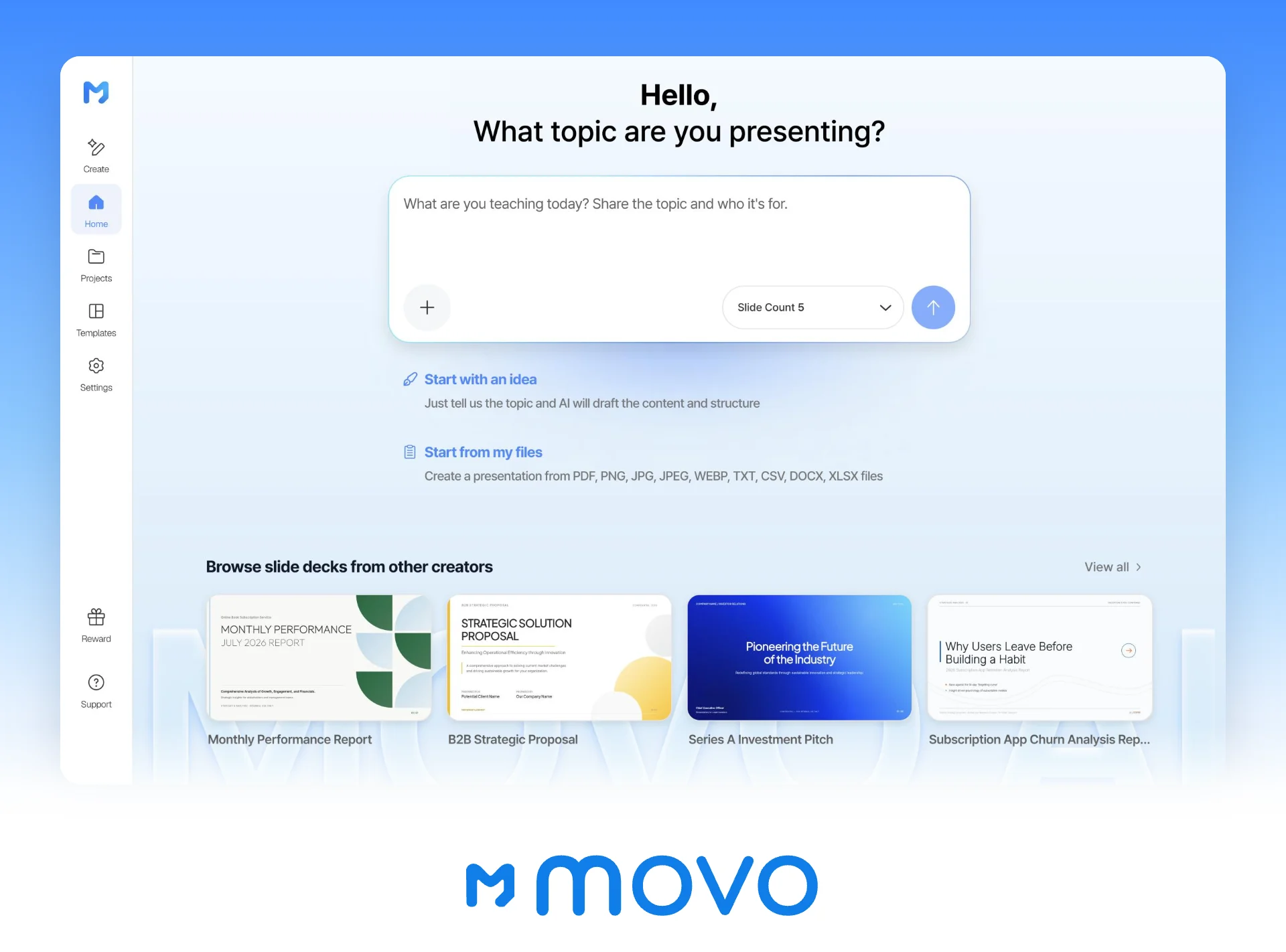
The pictures below show MOVO's screens filled with this article's example deck, the Series A pitch template. They illustrate the steps; they are not a recording of a real session.
1. Attach your material and describe the deck
In the dashboard input, say which room the deck is for and what the AI must not change, and attach your company profile or results. Set the slide count here too.
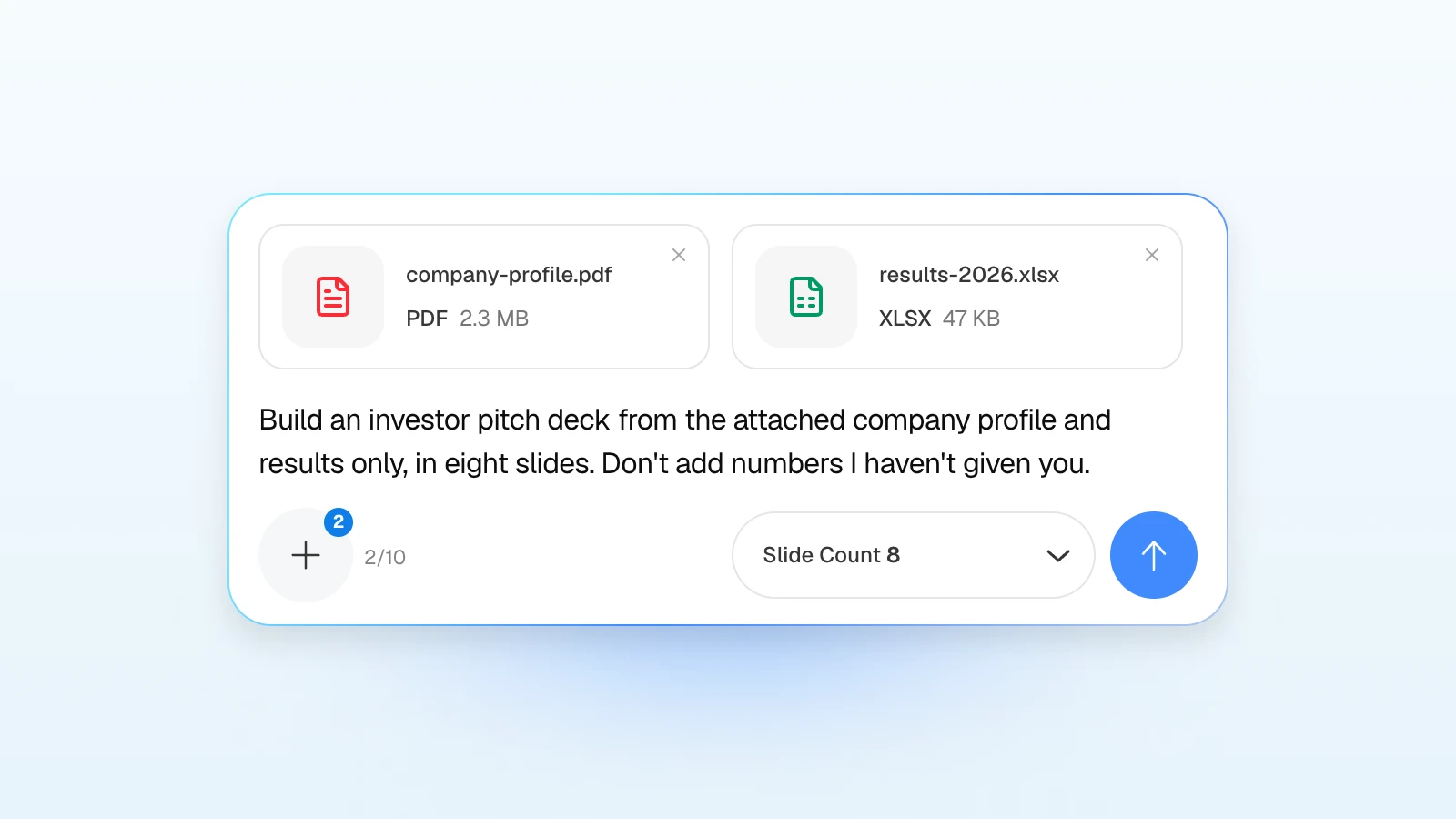
For a partner meeting:
Build an investor pitch deck from the attached company profile and results only. Eight slides: cover, problem, solution, market size, business model, traction, team, the ask. Keep actuals separate from projections, and keep each metric's definition, period, and unit. Don't add numbers, competitors, or customer logos I haven't given you.
For a demo day slot, attach your current deck as a PDF:
Using the attached deck, make a two-minute demo day version: five slides, one idea per slide, short headlines. Keep every number exactly as it is.
2. Fix the outline
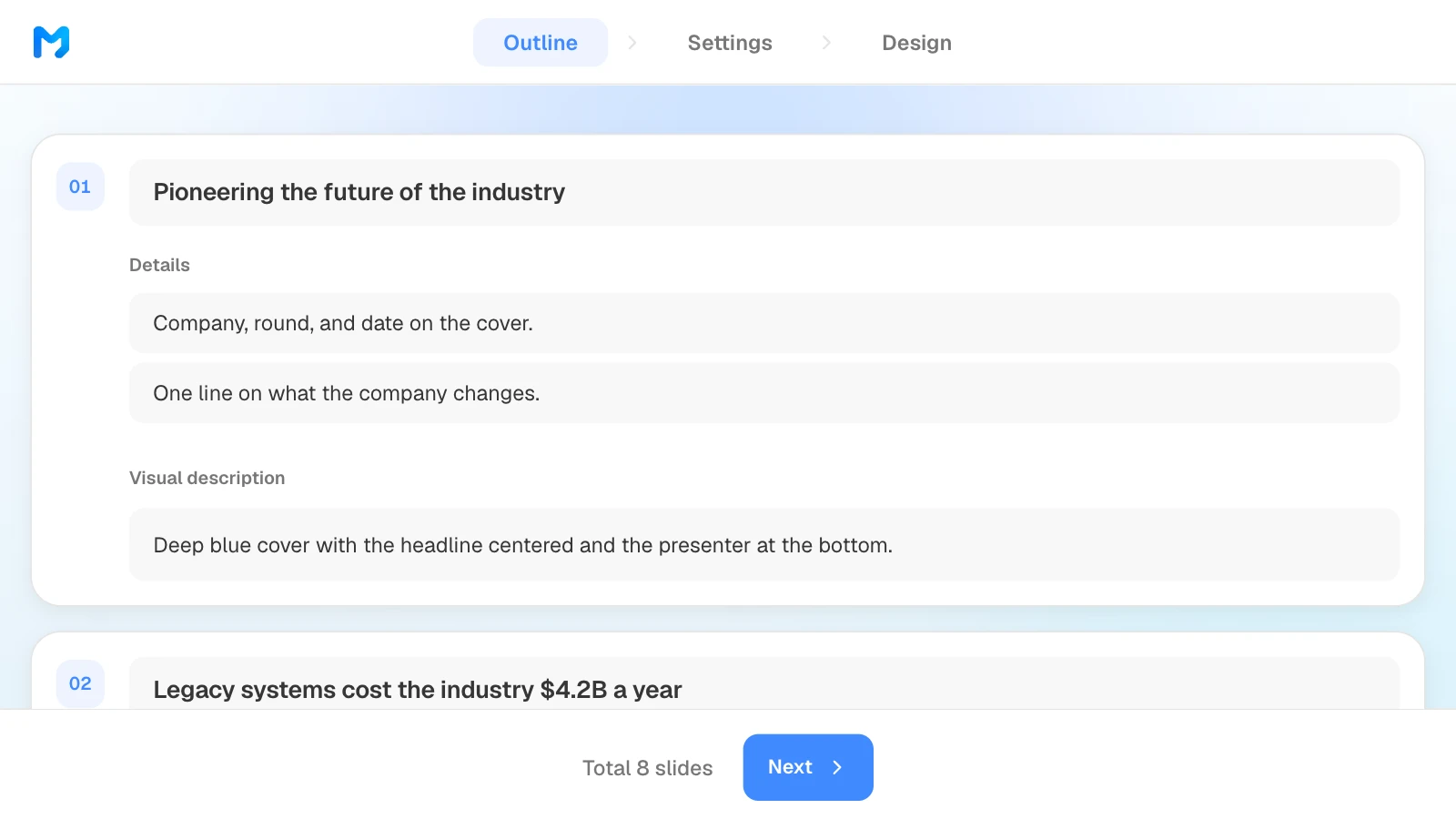
Review the titles and details MOVO suggests for each slide, edit them, and drag to reorder. The number of slides comes from the slide count you chose in step 1, so set a shorter count there for a short slot. What you change here is what gets built.
3. Set the audience and tone
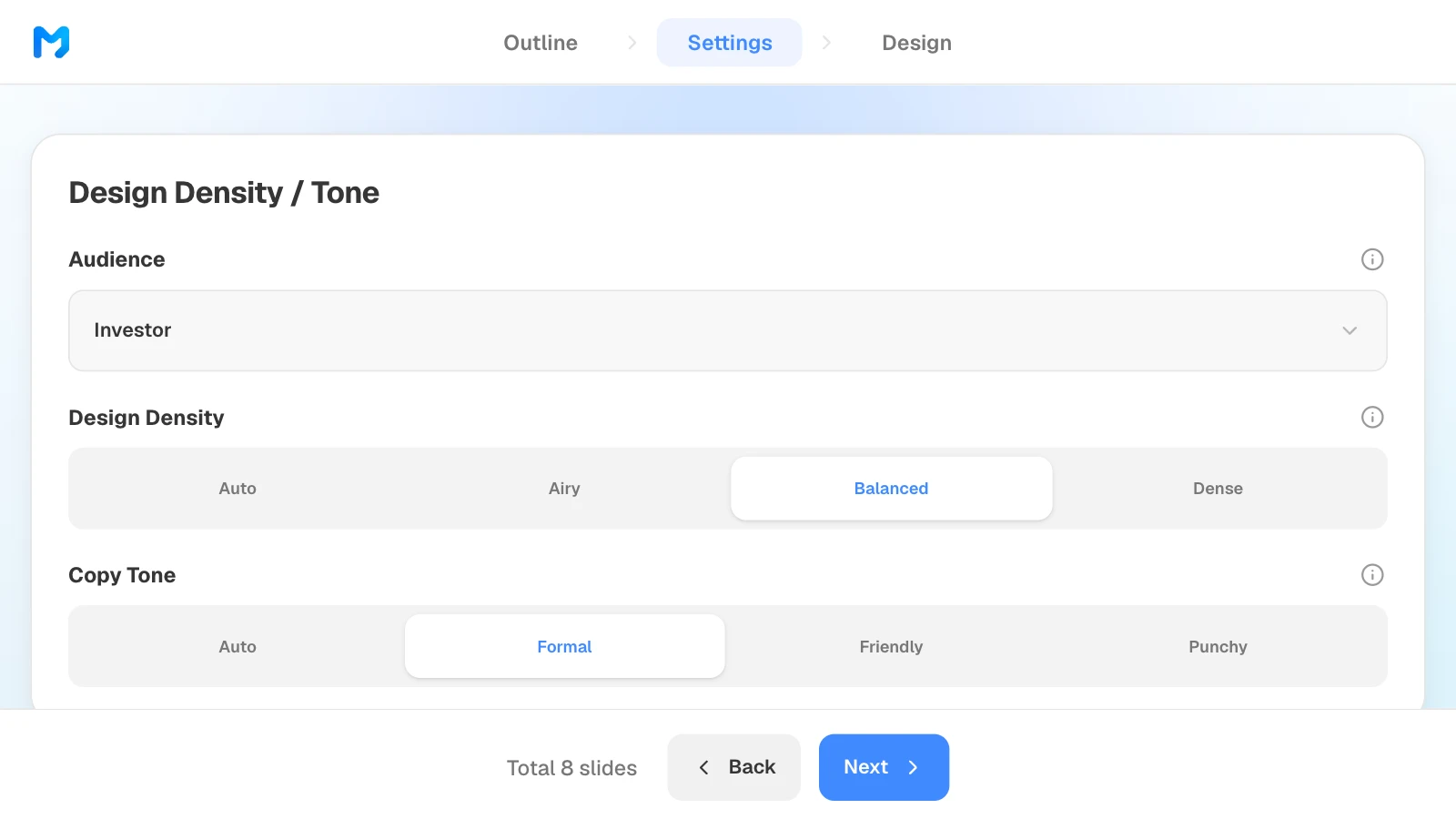
In settings, choose "Investor" as the audience, then set design density, copy tone, colors, and fonts.
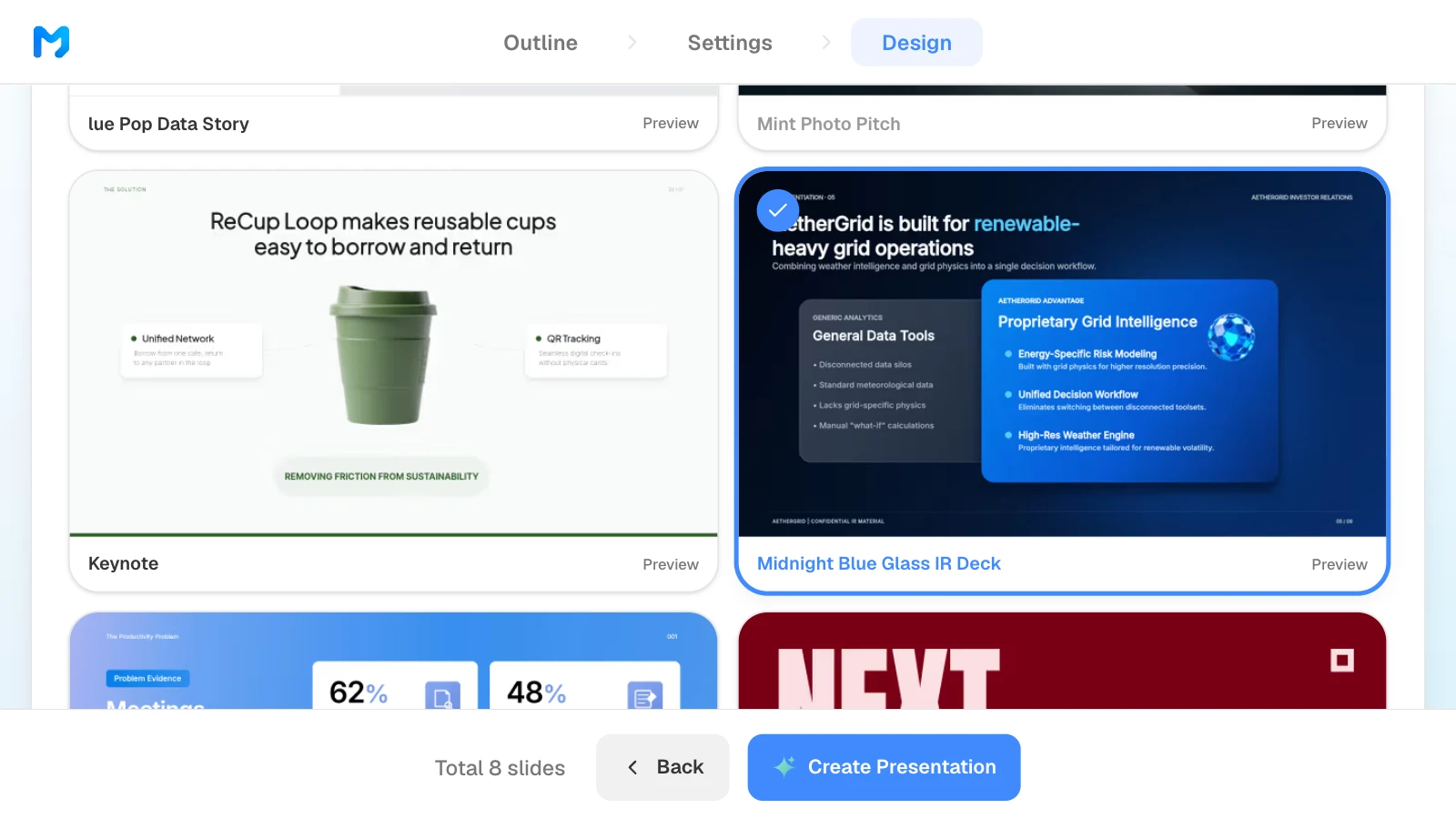
4. Pick a design
Choose "Presentation / Pitch" as the document type to see only pitch styles. Open "Preview" to see sample slides, then pick one. Styles marked "Pro" are available on paid plans.
5. Check the numbers and fix only what is wrong
Compare market figures, traction, and competitor claims in the finished slides with your sources. To fix one, select the slide and ask in the AI panel on the left, or edit it on the canvas.
6. Export the file
Send a PDF when the deck is for reading, and a PPTX when the recipient needs to edit it. When you choose PowerPoint, MOVO lists the fonts the deck uses so you can install them on the presenting computer.
Two IR deck templates to start from
These MOVO templates are written for a global investor audience, with figures in US dollars. The companies and numbers in them are fictional and show structure only. Copy one into your projects and replace the content.
1. Series A Investment Pitch (8 slides)
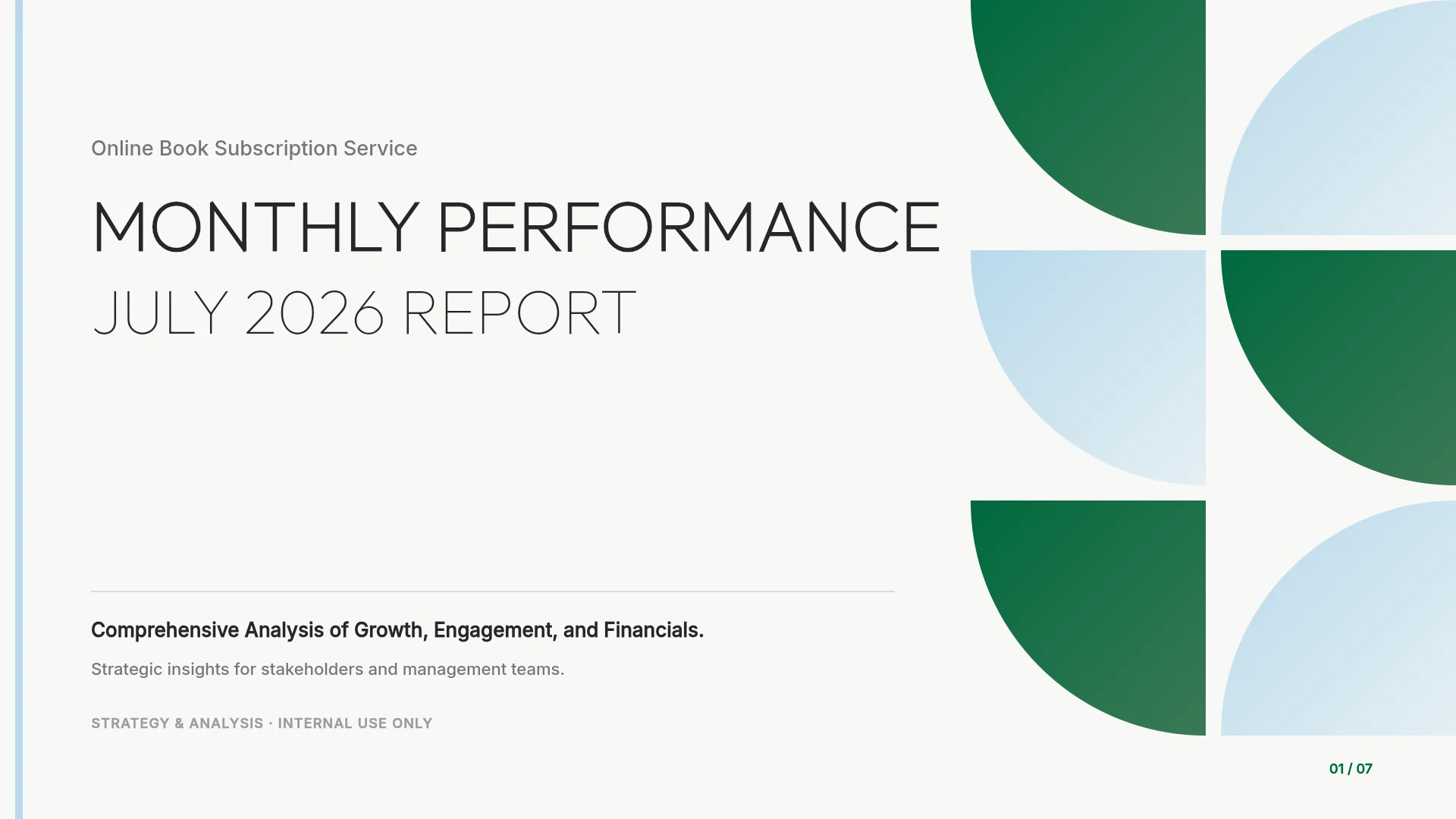
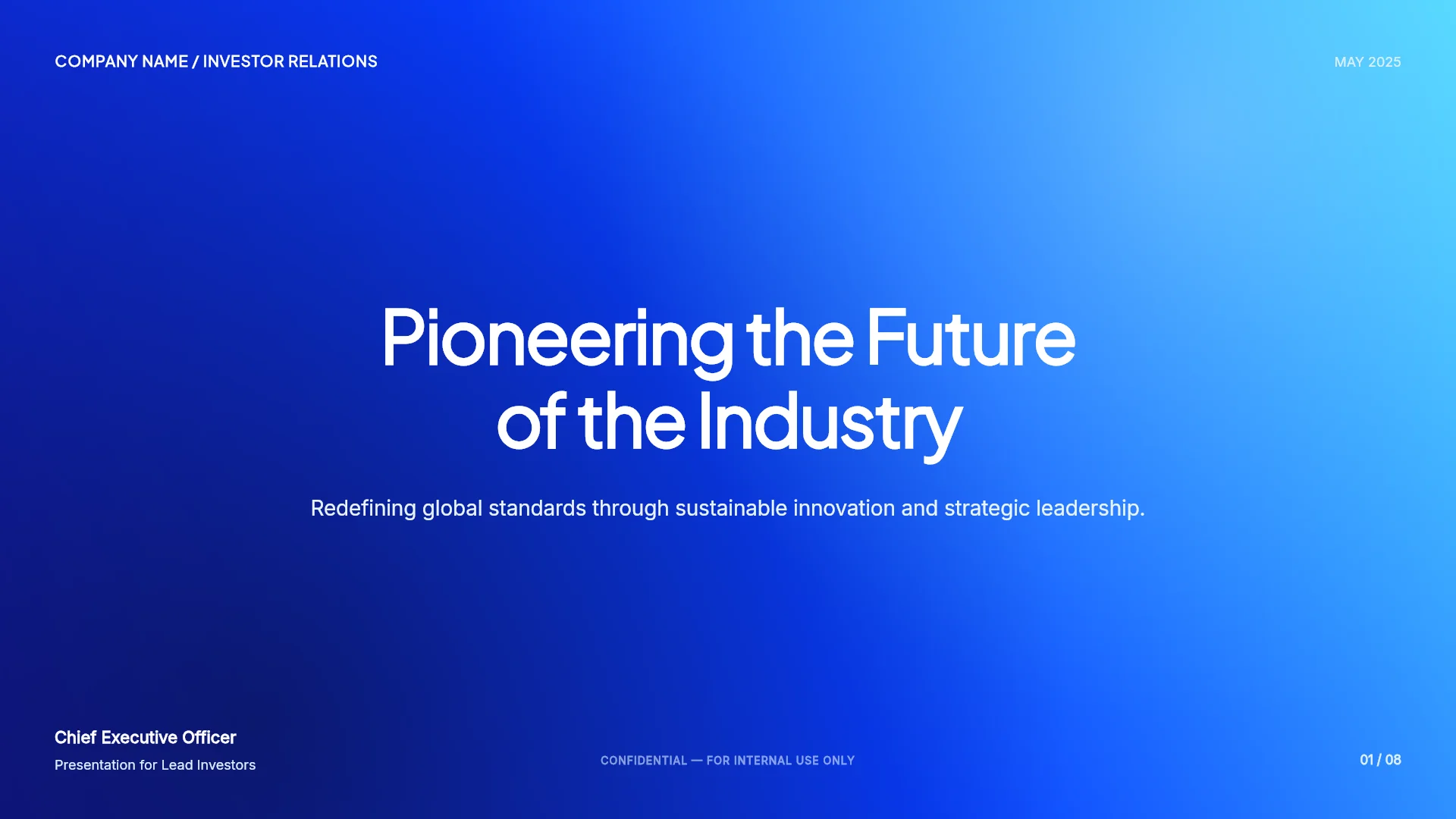
A Series A pitch built on recurring revenue: a $4.2B problem, a $42B global market, $3.4M ARR, a founding team, and a $5M raise with use of funds. Fits teams with revenue that need to show how they will scale.
View the Series A Investment Pitch template
2. D2C Beauty Global Export Pitch (8 slides)
A direct-to-consumer beauty brand pitching global expansion: market landscape, brand positioning, product portfolio, digital growth strategy, and revenue growth in US dollars. Fits consumer brands raising money or partners for international growth.
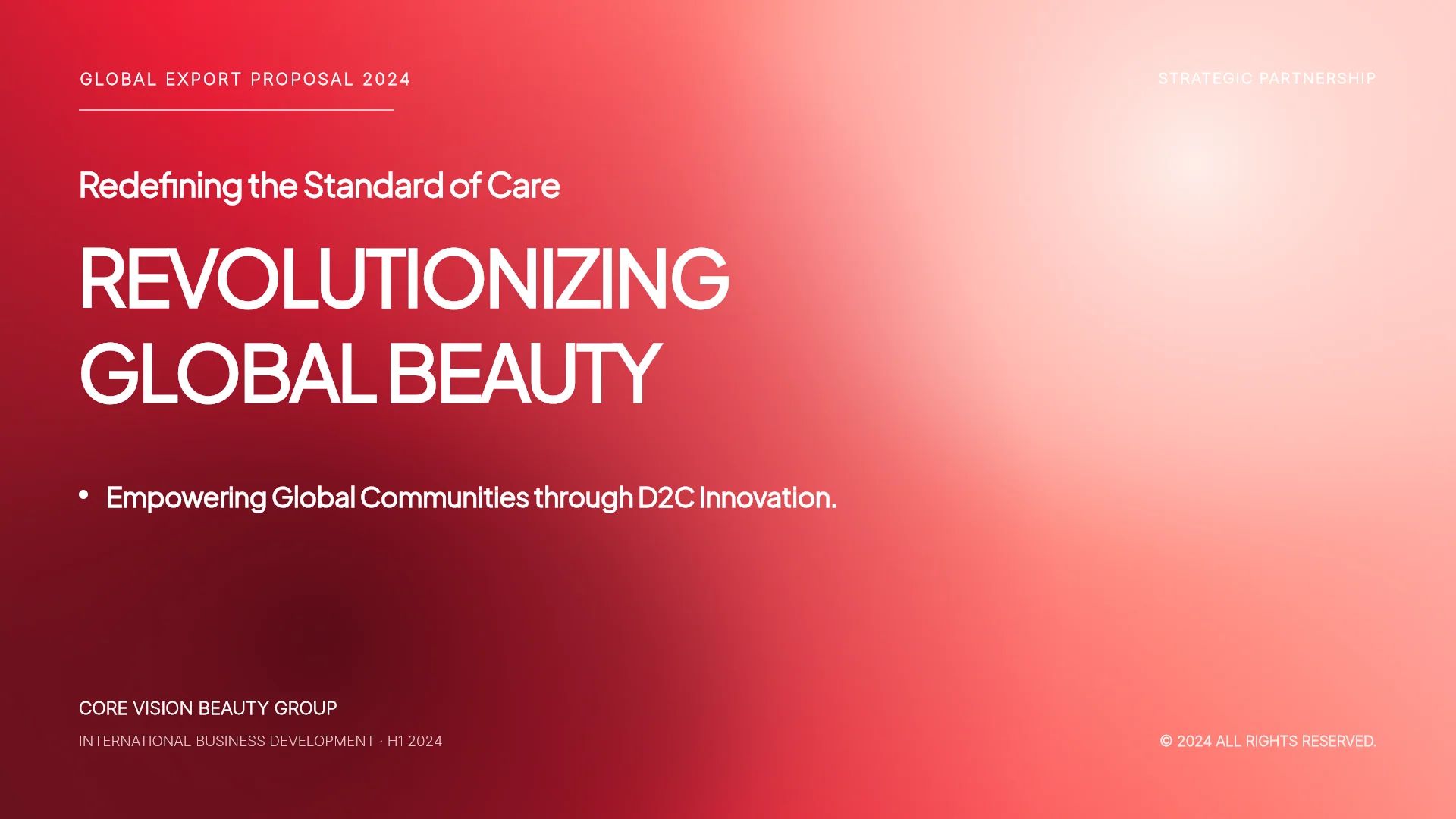
View the D2C Beauty Global Export Pitch template
Frequently asked questions
What does IR deck mean?
IR stands for investor relations. In startup fundraising, an IR deck is the pitch deck a company shows investors. The term is common among founders in Korea; US founders usually say "pitch deck" or "investor deck."
Is an IR deck the same as a pitch deck?
For a startup raising money, yes: both mean the slides you use to pitch investors. A public company's investor relations presentation, such as an earnings deck for shareholders, is a different document.
How many slides should an IR deck have?
There is no fixed number. Sequoia's outline has ten sections, and NFX suggests about 15 clean slides plus an appendix for partner meetings. A one- or two-minute demo day pitch needs far fewer. Fit the deck to the time you have and rehearse it out loud.
Should I send the same deck I present?
Usually not. A deck you present can lean on your voice, but a deck you send has to explain itself, often in two or three minutes of reading. Keep the same content in two versions: a presenting deck with fewer words and a send-ahead deck with clearer headlines, plus an appendix for questions.
Can I use AI-generated financial projections as they are?
Not as they are. A generated projection is not a confirmed result or an approved plan. Check its assumptions and math, and label projections apart from actual figures. Verify market and competitor facts against the original sources, and if evidence is missing, get the data instead of filling the gap with a convincing sentence.
Summary
An IR deck is your investor pitch deck, and its slides follow one arc from problem to the ask. Fit it to the room: a few slides for a one- or two-minute demo day, a full story plus an appendix for partner meetings, and self-explanatory slides for a deck you send ahead. Give every metric a definition and a period, and leave out numbers you have not verified. If you already have company material, put it into MOVO and start from the outline.